
Installing CCTV cameras in Abu Dhabi is not simply about choosing cameras, connecting them to a recorder, and monitoring your property. For many commercial and regulated premises, CCTV systems must be designed and installed according to the applicable requirements of the Abu Dhabi Monitoring and Control Centre (ADMCC).
If you are planning a new CCTV installation, upgrading an existing surveillance system, opening a commercial facility, or checking whether your current CCTV system meets Abu Dhabi requirements, understanding ADMCC approval is important.
This guide explains what ADMCC approval means, when it may apply, what a compliant CCTV installation involves, and how to choose the right CCTV installation company in Abu Dhabi.
What Is ADMCC Approval?
ADMCC refers to the Abu Dhabi Monitoring and Control Centre, the authority associated with surveillance and monitoring requirements in Abu Dhabi.
ADMCC requirements are intended to ensure that CCTV and related surveillance systems used at applicable premises are properly designed, installed, configured, documented, and maintained.
For businesses and property owners, ADMCC compliance is more than simply purchasing a CCTV camera from an approved brand. The complete surveillance solution may need to satisfy applicable technical, installation, recording, and documentation requirements.
This is why selecting an appropriately qualified and approved CCTV contractor is an important part of a commercial CCTV project.
Why Is ADMCC Compliance Important for CCTV Systems in Abu Dhabi?
A professionally designed CCTV system serves two purposes:
- It provides effective security and surveillance.
- It helps the applicable premises meet relevant regulatory and operational requirements.
A CCTV installation that has not been properly designed may create problems later, particularly when the system needs to be inspected, commissioned, upgraded, or documented.
For a business owner, choosing an experienced CCTV contractor at the beginning of the project can reduce the possibility of expensive modifications after installation.
The exact requirements can vary depending on the type of premises, project scope, and applicable regulations. Therefore, property owners should verify the current requirements that apply to their specific location and property category.
Who May Need ADMCC-Compliant CCTV in Abu Dhabi?
ADMCC-related CCTV requirements can be relevant to various commercial and institutional environments.
Depending on the applicable regulations, examples can include:
- Commercial buildings
- Offices and business centres
- Retail shops and commercial outlets
- Warehouses
- Industrial facilities
- Hotels and hospitality properties
- Healthcare facilities
- Educational institutions
- Financial and business establishments
- Government and semi-government facilities
- Other premises where regulated surveillance systems are required
The exact obligations should be confirmed for the individual property because requirements can depend on the premises type and current authority guidelines.
What About CCTV for Villas and Residential Properties?
Residential CCTV requirements can differ from those applicable to commercial premises.
A private villa may not have the same regulatory requirements as a commercial establishment. However, homeowners may still benefit from professionally designed surveillance covering entrances, driveways, parking areas, outdoor spaces, and other important zones.
For any property where regulatory compliance is relevant, it is advisable to confirm the applicable requirements before purchasing or installing the system.
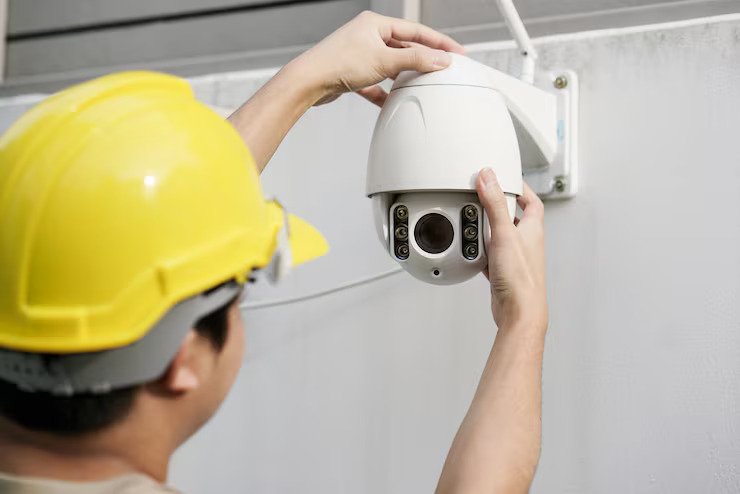
What Does an ADMCC-Compliant CCTV System Involve?
ADMCC compliance is not determined by the camera model alone.
A proper CCTV project can involve several interconnected elements.
1. CCTV Camera Selection
The cameras should be selected according to the security requirements of the property.
Different areas may require different camera specifications, including:
- Indoor cameras
- Outdoor cameras
- Dome cameras
- Bullet cameras
- High-resolution cameras
- Night-vision cameras
- Wide-angle cameras
- PTZ cameras
- IP network cameras
- Cameras with intelligent video features
The objective is to select equipment that provides sufficient image quality for the intended surveillance area.
2. Camera Positioning and Coverage
Even a high-resolution camera can provide poor security coverage if it is installed in the wrong location.
During CCTV planning, the installer should consider:
- Entrances and exits
- Reception areas
- Parking spaces
- Perimeter areas
- Corridors
- Staircases
- Loading and unloading zones
- Cash or high-value areas
- Storage areas
- Critical access points
Camera height, viewing angle, lighting conditions, blind spots, and environmental conditions should all be considered during the design stage.
3. Recording and Storage
A CCTV system must be capable of recording surveillance footage appropriately.
Storage requirements depend on factors such as:
- Number of cameras
- Camera resolution
- Recording mode
- Frame rate
- Compression technology
- Required retention period
- Number of hours recorded each day
Simply installing a large number of cameras without calculating storage requirements can result in inadequate footage retention.
4. Network and Structured Cabling
IP CCTV systems depend heavily on reliable network infrastructure.
Poor-quality cabling, incorrect termination, network congestion, inadequate PoE capacity, or badly organised racks can affect CCTV performance.
For larger installations, CCTV should therefore be planned alongside the property’s structured cabling and network infrastructure.
TOPRE Technical Services also provides structured cabling, networking, fiber optic, wireless and other IT infrastructure services, allowing CCTV infrastructure to be integrated with the wider technology environment of a business.
5. CCTV Monitoring and Remote Access
Modern surveillance systems can provide authorised users with access to live and recorded footage through suitable monitoring solutions.
Depending on the system design, businesses may require:
- Central monitoring
- Control-room viewing
- Remote monitoring
- Multiple-user access
- Mobile viewing
- Recording playback
- Event notifications
- Integration with other security systems
Remote access should be configured carefully with appropriate security controls rather than simply exposing a recorder directly to the internet.
What Is the Difference Between an ADMCC-Approved CCTV Contractor and a Regular Installer?
This is an important consideration for businesses.
A general CCTV installer may be able to physically mount cameras and configure a recorder. However, a regulated commercial project may require a contractor with the appropriate approval, experience, technical capability, and documentation process.
An experienced compliance-oriented CCTV contractor can help with:
- Site assessment
- Surveillance planning
- Camera selection
- Camera positioning
- Storage calculation
- Network infrastructure
- Installation
- Configuration
- Testing
- Commissioning
- Documentation
- Maintenance
For projects where ADMCC requirements apply, businesses should verify the contractor’s current approval status and confirm that the proposed installation satisfies the requirements applicable to their premises.

How Does the CCTV Installation Process Work?
A professional CCTV project generally follows a structured process.
Step 1: Site Survey
The first stage is to inspect the property and understand its security requirements.
The survey can identify:
- Required camera locations
- Blind spots
- Lighting conditions
- Existing cabling
- Network infrastructure
- Equipment locations
- Recording requirements
- Areas requiring special surveillance
Step 2: CCTV System Design
After the site survey, the CCTV system can be designed according to the property’s requirements.
This includes determining:
- Number of cameras
- Camera types
- Camera locations
- Recorder specifications
- Storage capacity
- Network requirements
- Monitoring requirements
- Power and PoE requirements
Step 3: Equipment Selection
The appropriate cameras, recorders, switches, storage equipment, racks, cables and accessories are selected according to the project specification.
Step 4: Professional Installation
The installation team then handles:
- Camera mounting
- Network cabling
- Cable termination
- PoE/network connections
- Recorder installation
- Equipment configuration
- Monitoring setup
Step 5: Testing and Configuration
After installation, the system should be tested to verify that cameras are operating correctly and that recording, playback, connectivity and monitoring functions work as intended.
Step 6: Documentation and Handover
For regulated projects, documentation can be an important part of the completion process.
The handover information may include relevant system details, equipment information, camera locations and testing or commissioning records.
Step 7: Maintenance and Support
CCTV systems require ongoing maintenance.
Regular maintenance can help identify:
- Camera failures
- Storage problems
- Network issues
- Recording interruptions
- Poor image quality
- Cable faults
- Power problems
- Firmware or configuration issues
For businesses that depend on CCTV for security and operational monitoring, an Annual Maintenance Contract (AMC) can provide ongoing technical support.
Why Should You Avoid Installing CCTV Before Checking ADMCC Requirements?
One of the common mistakes businesses make is purchasing CCTV equipment first and thinking about compliance later.
This can create several problems.
Incorrect Camera Specification
The selected cameras may not provide the required image quality or functionality for particular areas.
Insufficient Storage
A recorder may not provide sufficient storage for the required recording period.
Poor Camera Placement
Incorrect positioning can result in blind spots and unusable footage.
Inadequate Cabling
Existing network infrastructure may not support the planned CCTV system properly.
Additional Installation Costs
If the original installation does not satisfy the applicable requirements, upgrading or replacing equipment can increase the overall project cost.
A better approach is to assess the property and applicable requirements before finalising the CCTV design.
ADMCC CCTV Compliance Checklist for Abu Dhabi Businesses
Before proceeding with a CCTV installation, consider the following:
Confirm whether ADMCC requirements apply to the property
Select an appropriately approved and experienced contractor
Conduct a complete site survey
Identify all critical surveillance areas
Prepare the camera layout
Select suitable camera specifications
Calculate recording and storage requirements
Assess network and structured cabling requirements
Plan power and PoE requirements
Configure recording correctly
Test all cameras
Test recording and playback
Verify monitoring functionality
Complete applicable commissioning documentation
Arrange ongoing maintenance where required
Common Questions About ADMCC CCTV Approval
ADMCC stands for Abu Dhabi Monitoring and Control Centre. It is associated with surveillance and monitoring requirements within the Emirate of Abu Dhabi.
Not necessarily. The applicable requirements depend on the type of property, its use, and the regulations governing the premises. Commercial and other regulated properties may have specific CCTV requirements. Property owners should confirm the requirements applicable to their individual premises.
No. Compliance is not simply about the camera brand or model. The overall system design, installation, configuration, recording, infrastructure and applicable documentation also need to be considered.
For premises subject to applicable ADMCC requirements, businesses should verify that the contractor they select has the appropriate approval and technical capability for the project.
The installation period depends on the number of cameras, property size, cabling requirements, network infrastructure, equipment availability and project complexity. A site survey provides a more accurate estimate.
There is no single fixed price for an ADMCC-related CCTV project.
The total cost can depend on:
- Number of cameras
- Camera resolution
- Camera type
- Recording requirements
- Storage capacity
- Cabling distance
- Network equipment
- Installation complexity
- Monitoring requirements
- Existing infrastructure
- Maintenance requirements
A site survey and project-specific quotation are therefore more useful than a generic CCTV price.
In some cases, an existing system can be upgraded rather than completely replaced. The feasibility depends on the current cameras, recorder, cabling, network infrastructure, storage and overall system configuration.
A professional assessment can identify which components can be retained and which need replacement.
Yes. CCTV systems should be checked periodically to ensure cameras, recording equipment, storage, network connections and monitoring functions continue to operate correctly.
For commercial properties, an AMC can provide scheduled maintenance and technical support.
Why Choose TOPRE Technical Services for CCTV in Abu Dhabi?
TOPRE Technical Services LLC provides CCTV installation and IT infrastructure solutions for businesses in Abu Dhabi.
Our services include:
- CCTV camera installation
- CCTV maintenance
- Structured cabling
- Network infrastructure
- WiFi solutions
- Fiber optic solutions
- Access control systems
- PABX and telephone systems
- PA and sound systems
- Automatic gate barrier systems
- GPS vehicle tracking
- IT infrastructure solutions
TOPRE states that it has more than 10 years of experience delivering IT solutions and provides CCTV and related infrastructure services in Abu Dhabi.
Our approach focuses on designing the security system around the actual requirements of the property instead of simply installing a predetermined number of cameras.
From site assessment and CCTV design to installation, configuration, testing and maintenance, our team can support businesses looking for a professionally planned surveillance solution.
Need an ADMCC-Related CCTV Solution in Abu Dhabi?
If you are opening a new business, moving into a commercial property, upgrading an existing surveillance system, or checking your current CCTV infrastructure, start with a professional assessment.
TOPRE Technical Services can assess your premises, identify your CCTV requirements and recommend a suitable surveillance and IT infrastructure solution.
Contact TOPRE Technical Services today to discuss your CCTV installation, upgrade or maintenance requirements in Abu Dhabi.
TOPRE Technical Services LLC
Abu Dhabi, UAE
Phone: +971 54 314 1660
Email: sales@topre.me
Final Note
ADMCC requirements and technical standards can change, and the obligations applicable to a property depend on its specific circumstances. Always verify the current requirements with the relevant Abu Dhabi authority and ensure that your CCTV contractor is appropriately approved for the work being undertaken.

Jayesh Nair is a Technical Security and IT Infrastructure Specialist with 15+ years of experience in designing, implementing, and managing advanced security and networking solutions across commercial, industrial, and residential sectors. He specialises in CCTV camera installation, structured cabling, access control systems, fiber optic solutions, wireless networking, PABX and telephone systems, GPS vehicle tracking, and complete IT infrastructure deployment. With extensive hands-on expertise, Jayesh has successfully delivered reliable, scalable, and compliance-focused security and networking projects for businesses of all sizes. He is passionate about helping organisations enhance operational efficiency, strengthen physical security, and build future-ready IT infrastructure through industry best practices and cutting-edge technology.